Pine Ridge
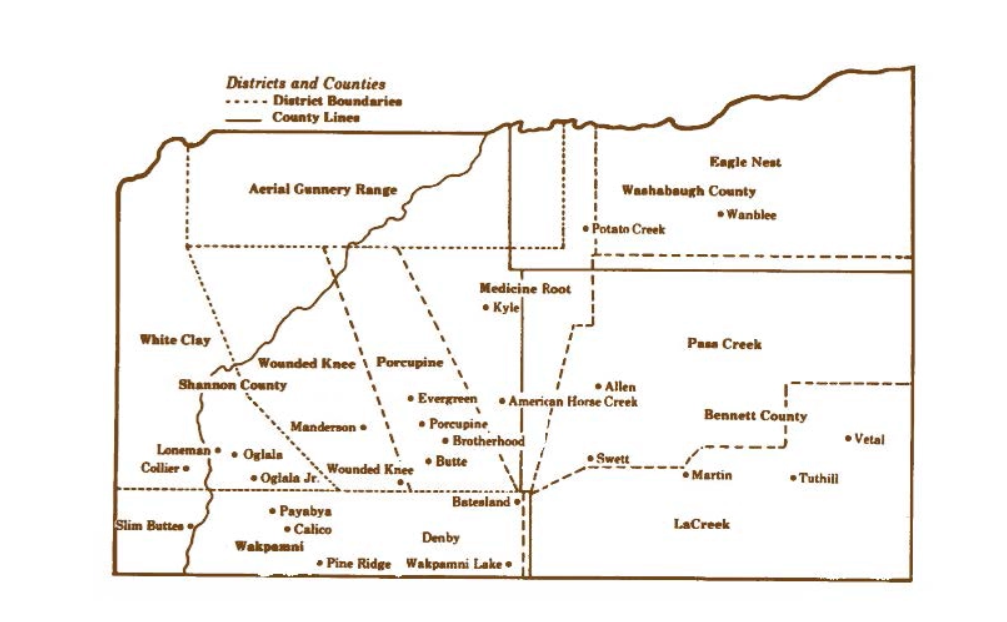
"The Pine Ridge Indian Reservation (Pine Ridge) covers a vast geographical area in southwestern South Dakota and northwestern Nebraska. Pine Ridge is among the largest of the reservations in the United States. It consists of 3.5 thousand square miles, more than twice the size of Rhode Island. Pine Ridge consists of nine districts and over fifty distinct communities/neighborhoods. Individuals of both American Indian and non-Indian ancestry reside within reservation land boundaries."
Source: https://www.oglala.gov/
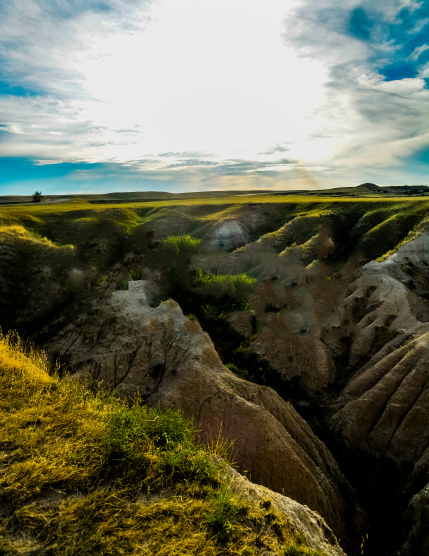
“Pine Ridge” is a literal translation of the Lakota word Wazi ahanhan, descriptive of the topography of the reservation. The land is rolling prairie “broken by whiteface buttes dotted with yellow pine (Powers, 1977)” Pine Ridge Indian Reservation is located in the southwestern corner of South Dakota (see maps). The reservation covers 2,786,540 acres. 707,246 acres are owned tribally. The badlands extend into the northern portion of the reservation. The western portion of the reservation leads to the foothills of the Black Hills. Additional acreage is covered by grasslands and spotted pine forests.

Information from : Oglala Religion by William K. Powers. University of Nebraska Press, Lincoln/London, p. 52-107. And American and Indian Reservation and Trust Areas by Veronica Tiller. Tiller Research Inc. Alburquerque, NM, 1996. p. 560-561.
The Lakota Sioux
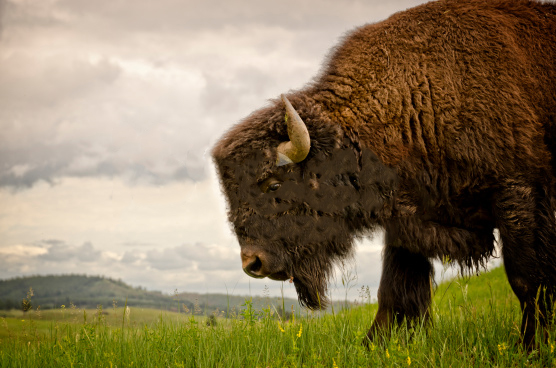
The western Sioux people and the language are represented by the term “Lakota”. The Oglala Sioux nation divided into seven tribes in the late 1700’s. They lived in most of South Dakota, Montana, Wyoming and Nebraska. They hunted and gathered for food, relying largely on the buffalo for survival. The western expansion of white settlers and miners promoted the Red Cloud Wars of the 1860’s. This was the only time American Indians successfully waged war against the US Government. In 1868, with the signing of the Treaty of Fort Laramie, the Lakota people were given the land of the Pine Ridge Indian Reservation. This original treaty included the lands of the Black Hills and a much larger portion of South Dakota. Since the discovery of gold and the influx of miners the treaty has been broken, and the Lakota have been forced to live in a smaller area with fewer natural resources. In 1890 the US Cavalry killed 300 men, women and children at Wounded Kneed Creek. This massacre has become a symbol of oppression for all Lakota people. Additional oppression has taken place over the broken Fort Laramie Treaty. This issue has been taken all the way to the Supreme Court to try to get the US government to honor the original treaty (United States vs. Sioux Nation of Indians.) In 1980, the Supreme Court would not grant the land back to the Lakota people. Instead, the government granted them a settlement of $17.5 million dollars for the land at 5% interest per year since 1877, totaling 106 million at that time. The Lakota have rejected this money due to the principle of the treaty promise and also because the land is not valued for its financial resources, but a loss of a place that is sacred to the people and believed to have healing power. The money has been place into an account where it continues to draw interest today.
 Information from: American and Indian Reservation and Trust Areas by Veronica Tiller. Tiller Research Inc. Albuquerque, NM, 1996. p. 560-561. And www.airc.org/living/housing.html.
The Pine Ridge Reservation is divided up into nine districts, as show on the map below. For more information, you can visit the Oglala Sioux Tribe's website at www.Oglala.gov.